In recent years, the love for coffee in Ukraine has been turning from a simple consumer interest into a desire to understand the entire chain — from the bean to the cup. One of the most interesting questions that is often heard in coffee communities and on the pages of producers is: is it actually possible to grow a coffee tree at home in Ukraine or even obtain fruits in a greenhouse? In this article, we will break down the myths, look at real experiments, and give practical advice for those who want to try growing as a hobby.
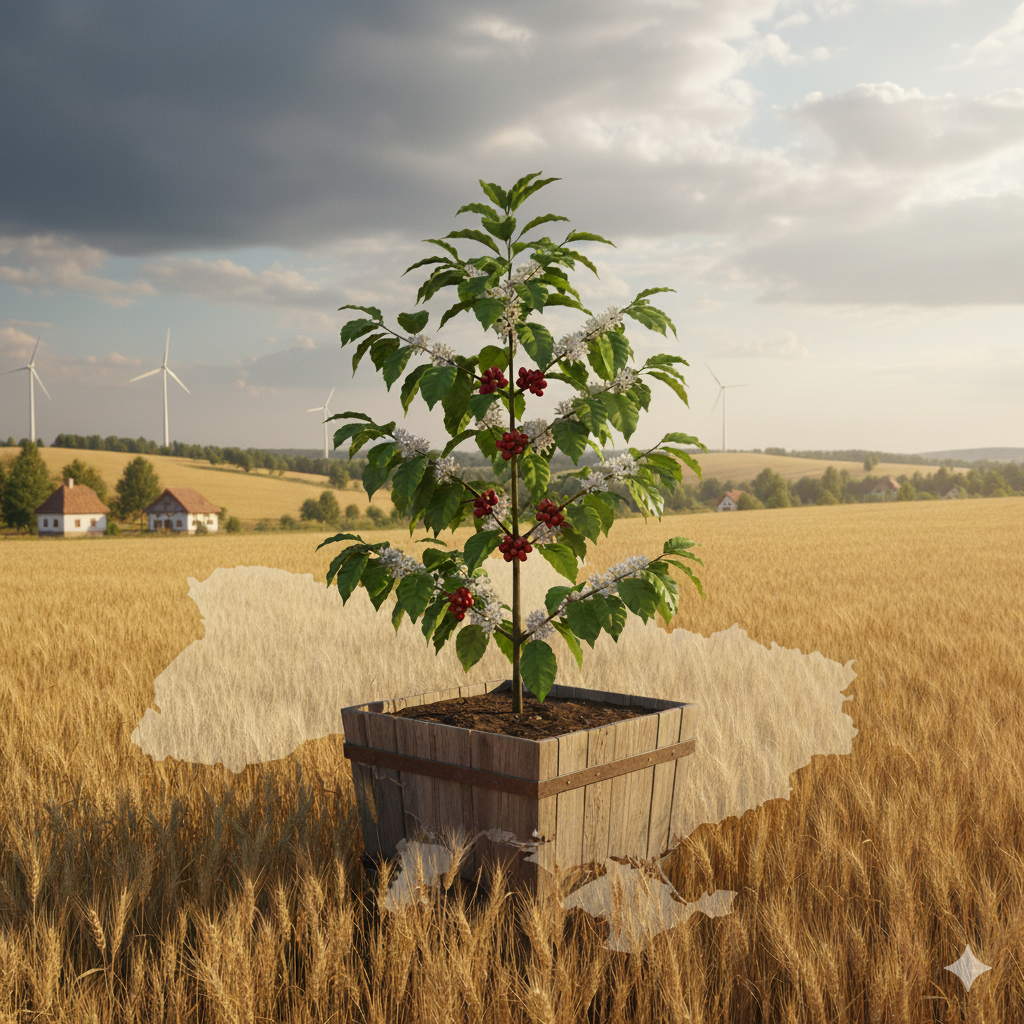
Short introduction: myths versus facts
• Myth: coffee can be grown anywhere and easily — this is partially true. As a houseplant — yes. As a full-fledged plantation in open ground in Ukrainian latitudes — no.
• Reality: modern experiments show that in a controlled environment (greenhouses, conservatories) it is possible to achieve flowering and even harvest berries, but this is resource-intensive and is more suitable for scientific laboratories or hobby enthusiasts than for mass production.
What climate coffee likes?
Classic Arabica (Coffea arabica) grows within the tropics at elevations of 800–2000 m, where the average daytime temperature is about 18–24 °C, with minimal night fluctuations and stable humidity. The optimal average temperature for Arabica is approximately 18–21 °C, and the plant is sensitive to drought and severe frost. Robusta (Coffea canephora) is more tolerant of lower temperatures, but also does not withstand winter.
Why this matters for Ukraine
The Ukrainian climate (continental, with cold winters) does not correspond to the tropical environment. Therefore, growing coffee in open soil is mostly impossible without protection. But in greenhouses or as a houseplant — the chances are much better.
A greenhouse as an option — what experiments show
A number of experiments in Europe and the USA prove: with the correct regime of light, humidity, and temperature, a coffee tree can bloom and produce berries in greenhouse conditions. For example, small studies at WUR (Wageningen) showed that Arabica plants can bear fruit in greenhouses under controlled light and humidity. Similar experiments were carried out in the USA (Florida), where coffee adaptation was tested as an alternative crop under protected-ground conditions.
Practical parameters for a greenhouse
• Temperature: during the day ~20–25 °C, night drops to ~15–18 °C.
• Humidity: 60–80% — coffee needs relative humidity close to tropical.
• Light: bright diffused light; with a deficit — additional full-spectrum LED lamps.
• Soil: light, fertile, well-drained, with acidity pH ~5.5–6.5.
• Watering and drainage: regular, but without water stagnation.
Growing as a hobby — realistic expectations
If your goal is simply to have a beautiful and aromatic potted specimen (which will sometimes even bloom), then growing coffee in Ukraine as a hobby is completely realistic. Advantages of hobby growing:
• Live greenery and the aroma of flowers.
• The possibility of obtaining a few berries (after 3–5 years from a seed or faster from a grafted seedling).
• Educational and therapeutic effect: caring for the plant, understanding growth processes, observing flowering and fruiting.
How long do you need to wait for the first harvest?
From 2–5 years depending on establishment, variety, and conditions. Plants grown in home conditions usually give small harvests — a few dozen berries if everything is favorable.
Which varieties to choose for home or greenhouse growing
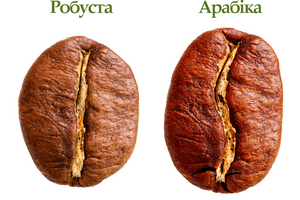
• Arabica — the most popular among home plants due to its taste qualities; suitable for greenhouses with controlled climate.
• Robusta — more tolerant of pests and higher temperatures, but the taste differs.
• For hobby growing: pay attention to hybrids and varieties labeled “houseplant,” or seedlings from a reliable nursery.
Care and equipment — a starter list (hobby/greenhouse)
• Pot or containers with drainage; substrate based on peat/perlite/compost.
• Humidity control — air humidifier or mist system in the greenhouse.
• Lighting — auxiliary LED lamps when there is not enough natural light.
• Ventilation and heating system in the greenhouse (to avoid sharp fluctuations).
• Fertilizers for acid-loving plants, mulch, regular monitoring of pests.
Scientific perspective and innovations — what is worth knowing
Around the world, researchers are working on adapting coffee to climate change, studying genotypes and genotype-environment interaction (G×E) to create more resilient varieties. Some laboratory approaches have even experimented with growing coffee “in a test tube” or cell cultures as a response to climate risks. This gives hope for new methods of preserving genetic resources and, possibly, for future options for growing under atypical conditions.
Economics and practicality — is it worth doing this on a mass scale in Ukraine?
For mass growing in Ukraine today, there are many obstacles: the cost of heating and lighting systems for greenhouses, energy consumption, risk of diseases, and relatively low yields in non-ideal conditions. Therefore, at a commercial level it is more logical to focus on roasting, creating a unique product, and supporting the local producer — for example, when you buy coffee from the producer and support the development of the industry in Ukraine. This allows investment in quality, sustainability, and the local community.
Practical tips for those who still want to try
-
Start with a ready-made seedling — faster and easier than growing from seed.
-
Provide a microclimate: stable temperature, high humidity, diffused light.
-
Use trays with water or humidifiers to increase humidity.
-
Do not expect large harvests — focus more on the process and enjoyment of cultivation.
-
Documents and experiments: follow new scientific publications on coffee adaptation — this will help integrate best practices.
Summary — conclusions for the Ukrainian reader
• Growing coffee in Ukraine in open soil is almost impossible due to winter frosts and continental climate.
• As a hobby: yes — a coffee tree is well suited for a houseplant and may sometimes bear fruit.
• In a greenhouse: it is technically possible to obtain berries, but it requires investments and climate control; such projects most often have a scientific or demonstrational character.
If you are a producer, an enthusiast, or simply love coffee and want more “from bean to cup” articles, Trevi is happy to share knowledge about coffee and roasting technologies. And if you want to buy high-quality coffee beans from our team — we will always be glad to help you choose a variety.
Sources and recommended literature (briefly): experiments on coffee growing in greenhouses (WUR), experiments in Florida (UF/IFAS), scientific works on the impact of climate on Coffea, articles on caring for a coffee tree as a houseplant, reports on growing coffee in laboratory conditions.